December 2025: Light, Hope, and Belonging All Month Long
December 2025: Light, Hope, and Belonging All Month Long
December is full of moments when people around the world honor memory, light, liberation, and belonging. For many in the Affirmation community, these days overlap: we may be LGBTQIA+, people of faith, family members, migrants, people of color, or all of the above.
This month, we’re pausing to notice some of the observances that may be meaningful to you—and to share an important invitation to gather as a global community around light, hope, and belonging.
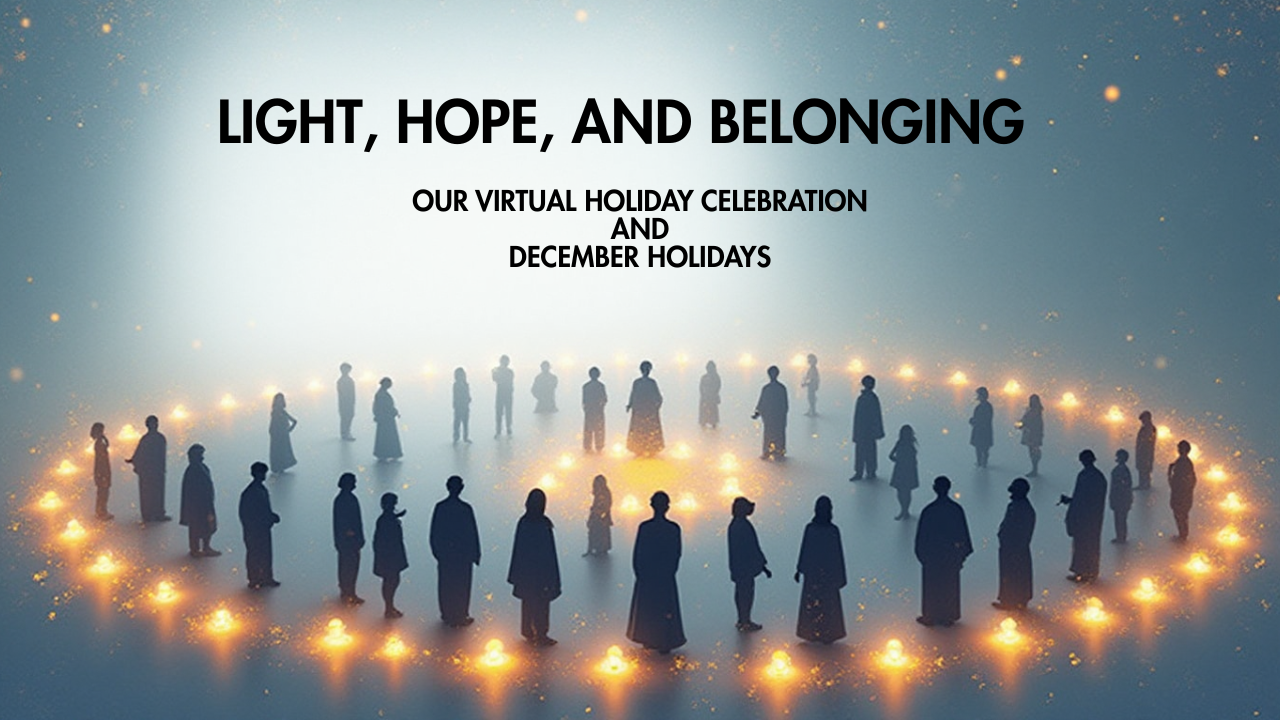
Save the Date: Affirmation’s 2025 Virtual Holiday Celebration
“Light, Hope, and Belonging”
Sunday, December 14, 2025 — 10:00–11:30 a.m. MT
Online via Zoom • Interpretation in English, Spanish, and Portuguese
As the year draws to a close, Affirmation: LGBTQ Mormons, Families & Friends will host a 90-minute Virtual Holiday Celebration centered on the theme “Light, Hope, and Belonging.”
The program will weave together:
-
Music, readings, and stories from around the world
-
A celebration of holiday traditions from different cultures
-
Presentation of the Mortensen Award
-
Small-group breakout rooms for connection and sharing
-
A multilingual closing blessing for the year behind us and the one to come
Whether you’ve been deeply involved with Affirmation this year or are just discovering us, you’re invited. This is space to exhale, to remember you are not alone, and to step into the coming year with a little more courage and connection.
Save the date and register:
https://staging.affirmation.org/light-hope-and-belonging-join-affirmations-2025-virtual-holiday-celebration/
With that gathering on the horizon, we also look at some of the days and traditions that shape this month of light and reflection.
Remembering and Defending Life: World AIDS Day
We begin the month with a day of memory and courage.
On World AIDS Day (December 1), communities around the world remember those we’ve lost to HIV & AIDS, stand with people living with HIV today, and challenge ongoing stigma. For LGBTQIA+ people, this day carries both grief and gratitude: grief for those taken too soon, and gratitude for the activists, caregivers, medical workers, and friends who insisted that our lives mattered when many institutions did not.
For Affirmation, World AIDS Day is a time to share stories from those impacted by HIV, highlight organizations doing lifesaving work, and recommit to responses rooted in compassion rather than shame. It’s one way we say: every body, every story, every breath matters.
Justice, Dignity, and the Work of Belonging
Throughout December, several global observances remind us that true belonging is always tied to justice.
-
The International Day for the Abolition of Slavery lifts up the ongoing fight against modern slavery and human trafficking.
-
The International Day of Persons with Disabilities honors the leadership, rights, and dignity of disabled people.
-
International Volunteer Day recognizes those who give their time and hearts to serve others.
-
International Migrants Day calls attention to the experiences of migrants and refugees around the world.
-
Human Rights Day marks the adoption of the Universal Declaration of Human Rights and the ongoing struggle to make its promises real.
Taken together, these days remind us that oppression is not abstract. It shows up in systems that exploit workers, exclude disabled people, push migrants to the margins, or treat LGBTQIA+ people as problems rather than neighbors.
Within Affirmation, we see these observances as invitations:
-
to examine how our own faith communities have sometimes harmed or excluded,
-
to make our spaces more accessible and welcoming to disabled LGBTQIA+ people,
-
to honor volunteers who make community possible,
-
and to stand in solidarity with migrants, refugees, and all those fighting for their basic rights.
When we talk about “safety, love, and hope,” this is what we mean.
Our Lady of Guadalupe: God at the Margins
On December 12, many Latine Catholics celebrate the Feast of Our Lady of Guadalupe, honoring Mary’s appearance to Juan Diego in what is now Mexico.
Images of Guadalupe often show Mary wrapped in symbols of indigenous identity and resistance. She stands not in marble halls or palaces, but close to those who are poor and overlooked. For many Latine LGBTQIA+ people and their families, this feast is a reminder that God shows up at the margins, speaking through familiar languages, brown skin, and everyday people—not only in official institutions.
For the broader Affirmation community, Guadalupe invites us to ask: Where have we seen grace appear in unexpected places? Who is God choosing to stand beside? And can we stand there, too?
Hanukkah: Light That Grows
This year, Hanukkah begins on the evening of December 14 and continues through the evening of December 22—the same day we gather for our Virtual Holiday Celebration.
The eight-day Jewish Festival of Lights remembers the rededication of the Temple in Jerusalem and the miracle of sacred oil that lasted longer than anyone thought possible. Each night, more candles are lit on the menorah, slowly increasing the light.
For Jewish LGBTQIA+ people, Hanukkah can hold both celebration and struggle: joy in tradition and community, and sometimes pain tied to antisemitism or to difficult experiences in religious spaces. In Affirmation, we honor Jewish members of our community by listening to their voices, challenging antisemitism wherever it appears, and recognizing that their stories are essential to the body of Christ, the human family, and our movement for justice.
The growing light of the menorah can also be a shared symbol: in a world that often feels dark, we practice adding one small flame at a time—one act of courage, one step of honesty, one community that chooses love over fear.
Las Posadas: Is There Room at the Inn?
From December 16–24, many communities across Latin America and the diaspora celebrate Las Posadas, reenacting Mary and Joseph’s search for lodging in Bethlehem. Groups go from house to house singing, often turned away at first, until one home finally opens its doors in welcome.
For many LGBTQIA+ people, this story feels painfully familiar: knocking on the doors of family, church, and community, not knowing whether there will be room for us. Too many have heard, “There’s no room here for someone like you.”
Las Posadas invites us to be the kind of people who open the door. In the context of Affirmation, it’s a chance to say plainly: There is room here—for your faith, your questions, your orientation, your gender identity, your grief, your joy.
The Longest Night, and the Turning Toward Light
On December 21, the Winter Solstice in the Northern Hemisphere, the night is at its longest and the day at its shortest. In many traditions, this day is marked as a turning point: from here on, the light slowly grows.
Many LGBTQIA+ people understand “long nights” in very personal ways—seasons of depression, family rejection, church discipline, or isolation. Sometimes those nights have come during the holidays themselves.
Honoring the solstice doesn’t require adopting a new religious practice. It can be as simple as lighting a candle and saying, in your own words: The darkness is real. And so is the slow, steady return of the light. If this December feels heavy to you, we hope you’ll feel permission to name that honestly—and to trust that more light is coming, even if you can’t see it yet.
Christmas: God With Us in Imperfect Places
For many in and around the Latter-day Saint tradition, Christmas Eve and Christmas Day are filled with church services, family gatherings, gifts, and carols. For others, they are days that highlight grief, loneliness, or painful memories. Within Affirmation, we recognize the wide range of experiences people carry into these days.
The story at the heart of Christmas is about God choosing to show up in an unexpected place: in a borrowed stable, among people on the margins, in a body that looked like any other baby’s. It is, in many ways, a story about a God who refuses to stay distant.
For LGBTQIA+ people of faith, that can be a lifeline. It suggests that Divine love is not waiting for us to become “acceptable” before drawing near. It comes right into the middle of our real lives—our families that don’t fit the script, our messy journeys with faith, our bodies that others have judged—and says, I am with you.
If this is a joyful season for you, we rejoice with you. If it is a complicated or painful one, we honor that, too.
Kwanzaa: Community, Heritage, and Collective Care
On December 26, many African diaspora communities begin Kwanzaa, a week-long celebration that continues through January 1. Kwanzaa is rooted in seven principles (Nguzo Saba), including unity, self-determination, collective work and responsibility, cooperative economics, purpose, creativity, and faith.
For Black LGBTQIA+ people, Kwanzaa can be a time to celebrate heritage, honor ancestors, and claim space in communities where sexuality and gender diversity have not always been welcomed. For the broader Affirmation community, it’s an opportunity to listen, uplift Black queer and trans voices, and ask how these principles might shape our shared work: building communities where everyone’s gifts matter and no one is left behind.
New Year’s Eve: Looking Back, Leaning Forward
Finally, we arrive at New Year’s Eve (December 31). Around the world, people count down to midnight, watch fireworks, and make resolutions. For some, it’s a night of parties; for others, a quiet evening of reflection.
Here in Affirmation, we might invite you to look back over 2025 and ask:
-
Where did I experience safety, love, and hope this year?
-
Who helped make that possible?
-
What did I survive that I want to honor in myself?
And then to look ahead and ask:
-
What is one intention I want to carry into 2026—for myself, my family, my faith journey, or my community?
-
Where do I want to create more room—for my own soul, and for others?
Advent, Christmastide, and the Season of Belonging
In many Christian traditions, the season of Advent runs from late November through December 24. It’s a time of waiting, longing, and preparing room for something new. For many LGBTQIA+ people, the experience of “Advent” has stretched across years—waiting for acceptance, for safety, for love that does not ask us to shrink.
The Christmas season, or Christmastide, continues into early January. In that sense, Christmas is not just a single day but a season of continuing to welcome love into the ordinary.
In the same way, belonging is not just one event, one meeting, or one blog post. It’s a season we keep choosing—together.
Wherever you find yourself this December 2025—celebrating, grieving, serving, resting, or some mix of all of the above—may you know this: you are worthy of light, of hope, and of a community that calls you by your name and your truth.